
When comparing SEO agencies, it’s common to see a wide range of prices for what appears to be the same service. Content production, link building and optimisation services often seem similar on paper, but pricing tells a different story.
These differences are not accidental. They reflect how agencies structure their work, allocate time and manage their resources. Understanding this is important when assessing what you are actually paying for, and why it is that some agencies are able to charge far less than others.
Cheap SEO content is not simply a lower-cost alternative. It is a high-risk strategy that often results in weaker performance, hidden remediation costs, reputational damage, and lost growth opportunities. While low-cost agencies can appear attractive in the short term, the true cost usually only becomes clearer over time.
Being informed on how agency pricing models will directly impact output quality is a critical part of building a long-term, high-performing SEO content strategy.
The Cost of Cheap Agencies
Using the cheapest SEO agency you can find is an obvious pull for many companies. It’s understandable why so many find it tempting. Why pay more when someone else claims to offer the same service for a fraction of the price?
For start-ups in particular, the cheapest option often looks like the safest choice. But the real question is why these agencies are able to charge so little in the first place. Are higher-priced agencies simply adding profit on top? Or are there concrete reasons for such wide cost gaps across the SEO industry?
Often, what sits behind these price differences isn’t so much the surface-level deliverables, but much more to do with how work is actually produced. Once you look behind the initial cost, you start to see a clearer picture around processes, talent security, and the long-term stability of your content strategy.
In practice, the easiest way to understand why some agencies charge less is to look at how their delivery model is structured.
A low-cost SEO agency model is typically characterised by:
-
No clearly defined editorial governance or named quality owner
-
No documented briefing methodology or commercial alignment process
-
Limited or non-existent quality assurance before publication
-
Content published without structured optimisation for search intent and performance
-
High freelancer turnover and inconsistent contributor standards
-
High account volumes per manager, limiting strategic focus per client
These models are designed for speed and margin, not for long-term performance, brand protection, or sustainable growth.
Ethical Content Production for Long Term Industry Stability
One of the primary ways agencies reduce costs is by paying freelancers below-market rates. This is not incidental, but a deliberate pricing strategy that allows agencies to operate at scale while shifting financial risk onto writers and editors. In a highly competitive market, many freelancers feel pressured to accept reduced rates simply to secure work. The long-term impact of this approach is market instability.
Undervaluing freelancers weakens the talent pipeline. As earning potential declines, experienced contributors leave the industry and fewer new writers and editors are able to enter it. This dynamic is documented in the Good Work Review on job quality in the Creative Industries, which highlights how low pay, insecure contracts, and poor working conditions systematically disadvantage freelancers and undermine industry resilience.
Over time, content production becomes an increasingly unsustainable career path. The industry becomes dependent on a small, overstretched pool of senior talent, reducing the diversity of skills and perspectives available. What begins as a cost-saving measure ultimately distorts the market, driving competition for remaining talent and pushing rates sharply upward. In effect, short-term cost cutting leads to higher long-term costs.
When the ability to secure reliable talent at a fair price diminishes, opportunities for new and capable content creators are also lost. This is not only an operational or economic issue — it is an ethical one, with lasting consequences for the health of the industry.
From the freelance side, the impact is already visible. As Ana Paula Picasso, SEO and growth strategist specialising in high-growth and fintech brands, explains:
“When rates drop, experienced writers leave, newer writers churn, and the talent pool narrows. Over time that pushes quality down and risk up for agencies and clients alike.
Editorial Governance and Quality Control
When you work with an agency, you’re not just paying for the freelancer. You’re also paying for someone to oversee the SEO content production from start to finish. You’re paying to ensure the content quality is what you need and expect. For cheaper agencies, this level of governance can be difficult to maintain or may not be prioritised at all.
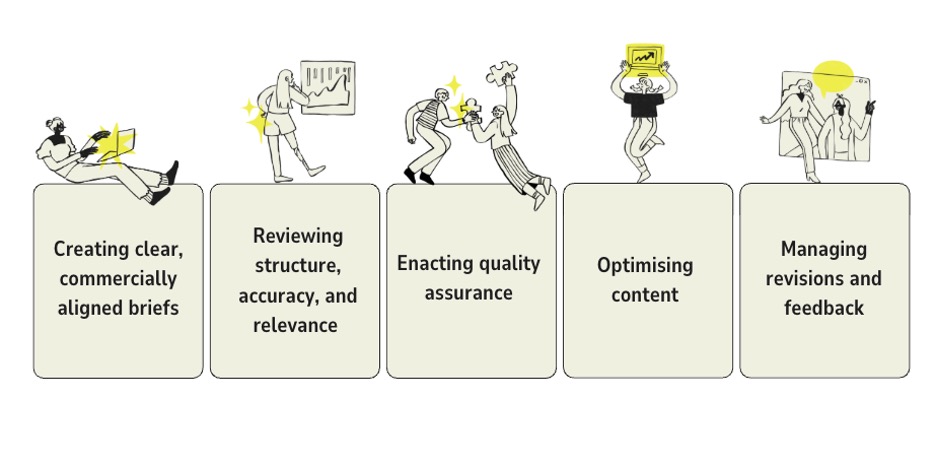
What you should be paying for is experienced staff who manage and protect quality at every stage. This typically includes:
-
Creating clear, commercially aligned briefs
-
Reviewing structure, accuracy, and relevance during production
-
Enacting quality assurance before anything is published
-
Optimising content for search intent and performance
-
Managing revisions and feedback with consistency and care
The more checks that exist between initial production and publication, the fewer opportunities there are for issues to slip through.
 It’s well known that a cheaper agency has to skip some of these steps, because they have to work at a much faster pace in order to make their profit. They need to cut corners in order to meet their margins. Many cheaper agencies take on significantly more clients in order to make money - which means less time is spent on each client, with less focus put into each piece of content produced. Quantity over quality.
In reality, these skipped steps often show up in very simple ways:
-
Briefs that lack direction or strategic context
-
Articles sent straight to publication without proper QA
-
Surface level edits that miss factual or structural issues
-
Content that never receives a meaningful optimisation pass
None of these issues are particularly dramatic in isolation. Taken together, however, they lead to inconsistent quality and unreliable results over time.
Content quality is essential in all elements of SEO. So is collaboration and understanding. Not being a priority to your chosen agency inevitably leads to weaker performances and poorer outcomes, even if that’s not what the agency intends. In this industry, you ultimately get what you pay for.
Working Relationships and Long Term Performance
Good working relationships are essential to good output. An agency should not just see you as a client, but as a co-worker. The work result should be equally as important to both of you. You should both have a shared goal that you care about and are working towards together.
A quantity-first agency simply does not have the time for this. They cannot consider the finer details, account for nuance, or understand brand identity. The focus becomes pushing content through at an “acceptable” level as quickly and cost effectively as possible. For some companies this might be ok, but for most, it’s an online reputation disaster waiting to happen.
The better you pay your agency, the more time they can dedicate to you. This leads to improved relationships, better communication, and ultimately, better output.
This dynamic does not only apply to the agency-client relationship. It also extends to an agency’s external partners, such as content creators, publishers, or consultants. When agencies are paid fairly by their clients, they can spend more time and budget across their entire processes.
More time and resources allow agencies to recruit a stronger talent pool, build relationships and expand their portfolios. When staff do not have to stretch themselves too thin to keep the money coming in, they can put real focus and energy into performing at a high standard and collaborating with the right people.
It means that they can pay their external partners more fairly, strengthening those relationships over time. Strong professional connections are built through consistency, mutual respect, and investment.
When Might a Cheap Agency Be Enough?
Of course, there are moments where a lower-cost agency could be a reasonable option. Short term projects, low visibility content, or early stage testing can sometimes justify going for a more economic alternative. For businesses with minimal brand risk or limited reliance on organic search, cheaper services may meet basic needs. The important thing is making that choice with a clear understanding of what is being traded off, and who ultimately carries the risk.
The risk is not in using a cheaper agency briefly, but in relying on one beyond its limits.When content becomes more visible and expectations increase, the consequences of weaker oversight or inconsistent quality tend to rise with it.
The Hidden Cost of Fixing Bad Work
A potential outcome of working with cheaper agencies is the need to fix or even undo work later on.
Poor briefs, limited checks and inconsistent content quality do not always cause immediate problems. More often than not, these issues build quietly in the background, becoming more difficult to ignore over time, until results plateau and corrective work is required
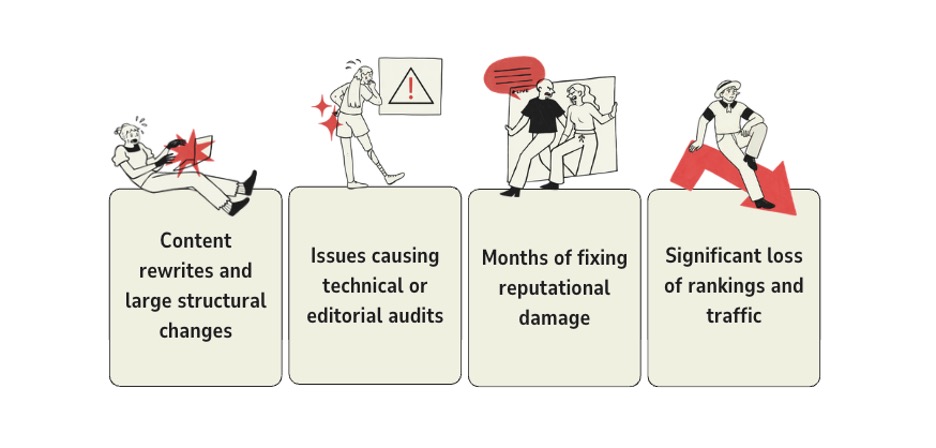
When issues arise, it often means that content ends up needing a significant overhaul. This can result in:
-
Content rewrites and large structural changes
-
Technical or editorial audits to uncover underlying issues
-
Reputation repair if low-quality content damages credibility
-
Lost rankings and traffic that can take months to recover from
By the time these problems surface, the cost of fixing them often outweighs what would have been spent on quality work from the start. In SEO, mistakes tend to compound, and recovery is rarely quick - or cheap.
As Picasso puts it:
“Cheap content does not save money. It shifts the cost downstream, into rewrites, audits, lost rankings, and lost trust.”
 The Importance of Audience Focused Content
When people think of SEO, they think of search engines. That makes sense, as search visibility is what it’s all about. But, importantly, a content strategy only works long term when its real priority is the audience, not the algorithm.
Cheap agencies tend to create content primarily for search engines. But as Google’s SEO Guide recommends, content should always be created primarily for users, not search engines. Content is shaped around ranking signals and short-term gains rather than long-term brand development. This approach is quicker, and easier, but risky. Google picks up on manipulation tactics well, and this only continues to improve over time.
Though yes, it’s possible to rank with purely SEO focused content, this type of content is risky. It technically goes against Google’s Policies, and if picked up on, could be flagged as spam and immediately deranked.
Building content around a client's audience takes time and attention. It requires a real understanding of who the content is for, how it represents the brand, and what purpose the content serves beyond ranking alone. These decisions are difficult to make consistently when content needs to be produced at a high volume.
As Picasso notes:
“A lot of cheap SEO content technically follows best practices, but it does not answer real questions or reflect how people actually search and read. Making SEO and AEO work for humans takes time, editorial judgement, and writers who understand the audience, not just the keyword list.”
Agencies that are properly resourced however, have the capacity to work this way. They can spend time shaping content with intent, ensuring it aligns with brand positioning and audience expectations, while still meeting technical SEO requirements. That balance is difficult to achieve when speed and output are the primary focus.
Over time, content produced with this level of care tends to perform more reliably and requires fewer ongoing corrections, even as Google Policies continuously change. Content created for real audiences is more credible, more resilient, and better suited to long-term growth.
What You’re Really Paying For in SEO
Price differences in SEO charges are intentional. They are a direct reflection of how an agency will treat you, how it manages its wider network of staff and partners behind the scenes, and how much time and budget it can realistically assign to your work.
Cheaper agencies charge less because they operate differently, often at higher volume, with fewer checks, less oversight, and tighter margins that leave little room for nuance or long-term strategic thinking.
For some businesses and situations, a lower-cost option can genuinely make sense. But for those thinking in the long term about brand visibility, reaching real audiences and company stability, it’s a real risk.
The true cost of cheap content usually becomes clear not in the initial invoice, but in the time, effort, and expense required to fix what was never built to last.
Paying more is not about buying content. It is about consistency, stability, skill, expertise, and quality. It’s about meaningful connections and shared goals. It is about industry stability and fair treatment. Ultimately, it is about investing in content that strengthens your brand, earns trust, and supports long-term growth.
You can find out more about Ana Paula Picasso and her work here: https://thefintechwriter.com/